Yard drainage and French drains
Most water under a house fell on its own roof and yard a few hours earlier. Moving that water away before it reaches the foundation is the first fix to consider. It makes every other fix work better.
Begin with the roof
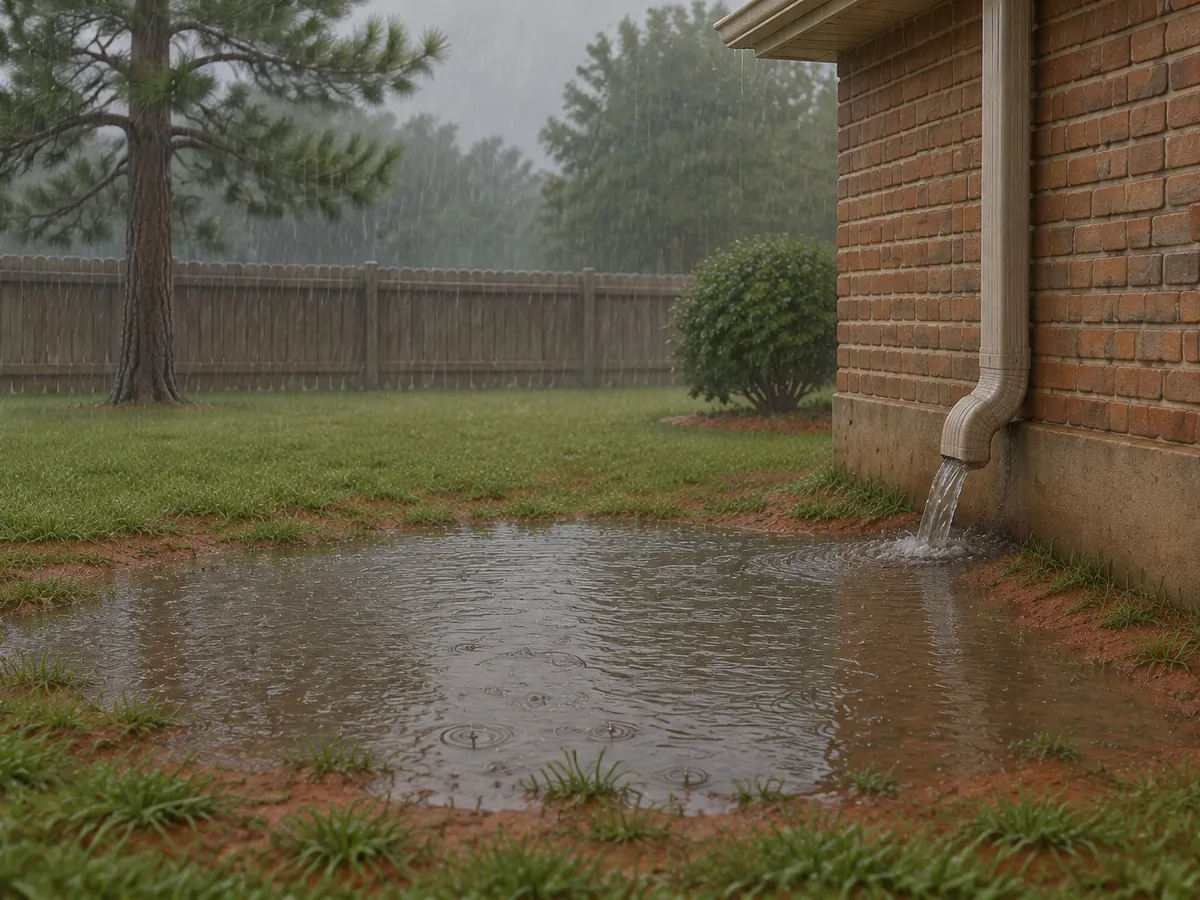
A roof sheds a great deal of water in a thunderstorm, and the gutters gather all of it into a few downspouts. If those empty at the foot of the wall, the foundation gets the whole roof's rain in a handful of spots. Walk round in a downpour and look.
The fix is to carry each downspout away: a solid pipe, buried at a gentle fall, ending where the ground drops off. Clean gutters matter as much. One that overflows dumps its water along the wall.
Then the slope of the ground
Soil settles next to a house over the years, and flower beds get built up with edging that traps water against the wall. The ground should fall away from the foundation on every side. Where it does not, soil is added and shaped, or a shallow grassed channel is cut to lead water round the house.
Keep soil and mulch below the top of the foundation and clear of the crawl space vents.
What a French drain is
A French drain is a trench with a perforated pipe in washed stone, wrapped in fabric, usually covered with more stone or turf. Water in soggy ground finds the stone, drops into the pipe and is carried off. It suits a yard that stays wet, or a slope that sends water toward the house from next door or from higher ground.
It works only if it has fall and somewhere to empty. In heavy clay, water reaches the trench slowly, so the drain is placed where the water already gathers. Catch basins with grates can be added at low spots to take surface water straight into the pipe.
Ask about a drainage plan
- Where does each pipe end? Have every outlet shown on a sketch of the lot.
- How much fall does the pipe have? Flat pipe holds water and silts up.
- Is the pipe solid or perforated, and where? Downspout lines should be solid so they do not leak roof water into the ground beside the house.
- Are there cleanouts? Roots and leaves get into every buried line eventually.
- Will this send water toward a neighbour? It should not. Ask how the plan avoids it.
Drainage questions
Will yard drainage alone dry out my crawl space?
It can stop puddles under the house. It will not stop summer humidity coming through the vents. Many houses need drainage for the liquid water and a liner or dehumidifier for the damp air.
Who do I tell about a blocked street drain or ditch?
It depends on who maintains the road. The local guide lists the city, Northport and county contacts.
Tell someone what you are seeing
Call and describe what is going on under the house or in the basement. You will be put through to an independent local waterproofing company that works in your part of Tuscaloosa County.
Calls may be recorded. The company pays this site for the introduction. See the referral disclosure.