Basement leak repair and wet basements
A wet basement is not always a big job. Sometimes one crack, one window well or one downspout is behind it. The work is in tracing the water back to where it gets in, and that starts with what you can see.
Where it shows, and what that suggests
| Where you find water | Likely source |
|---|---|
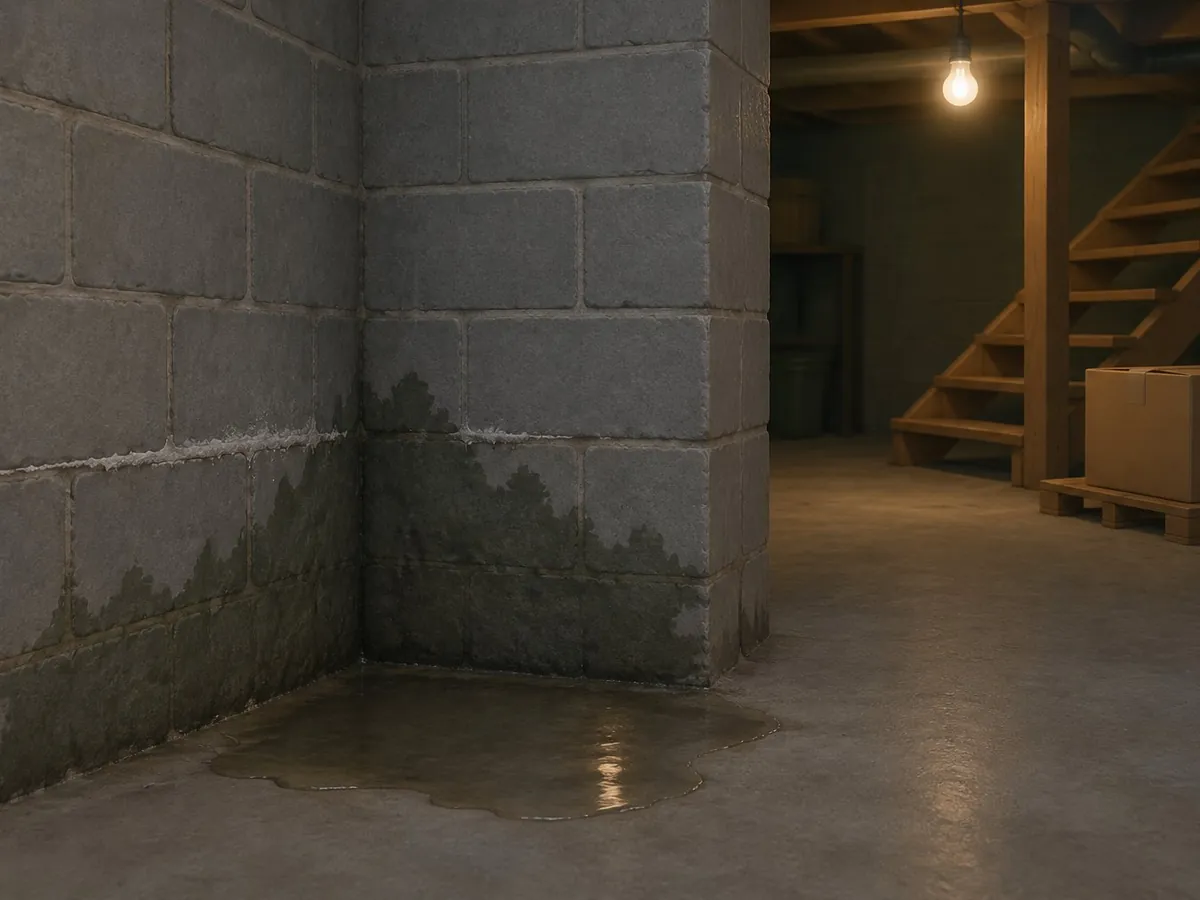
| Along the foot of one wall | Groundwater at the wall and floor joint. Check the downspout and the slope of the soil outside that wall first. |
| A thin line running down the wall | A crack, or the round tie holes left when a concrete wall was poured. |
| Below a basement window | A window well that fills because its drain is blocked or missing. |
| Around a pipe or cable | The seal where a service passes through the wall has failed. |
| Middle of the floor | Water pressure under the slab coming up through a crack, or a floor drain backing up. A drain that backs up is one for a plumber. |
| Everywhere, as a film | Condensation on cool surfaces in humid weather. See the test below. |
Seepage or condensation: a two-day test
Tape a square of clear plastic or kitchen foil flat against the damp part of the wall, sealing all four edges. Leave it for two days. Moisture on the room side means humid air is condensing on a cool wall, and the fix is drier air. Moisture trapped behind the plastic means water is coming through the wall.
Tell the company which it was. It saves them guessing.
Repairing a single leak
A crack in a poured concrete wall can often be sealed from inside by injecting it with a resin that fills it through the wall's full thickness. Tie holes and gaps around pipes are plugged in a similar way. A window well is dug out, given clean stone and a drain, and sometimes a cover.
Block walls are different. Water travels inside the hollow cores, so sealing one joint moves the leak along. Persistent leaks in block usually lead to an interior drain along that wall.
What to note before you call
- Which wall, and whether it faces uphill.
- How long after rain the water appears, and how long it stays.
- Whether it happens in every storm or only the long, soaking ones.
- Where the nearest downspout empties.
- Whether the crack is new, growing, or wider at one end.
Photos taken while it is wet are worth more than any description. If the yard is part of the cause, see yard drainage.
Ask about a leak repair
- Is this crack only leaking, or is the wall moving? If it is moving, sealing it is not the whole answer.
- What material goes into the crack, and why that one? Flexible and rigid resins suit different cracks.
- What if it leaks again beside the repair? Ask what the written warranty says about that.
Tell someone what you are seeing
Call and describe what is going on under the house or in the basement. You will be put through to an independent local waterproofing company that works in your part of Tuscaloosa County.
Calls may be recorded. The company pays this site for the introduction. See the referral disclosure.