Basement waterproofing in Tuscaloosa
If your house has a basement, or a lower level cut into a slope, the soil against its walls holds water after every long rain. Interior waterproofing does not try to keep that water out of the wall. It gives the water an easy path to a drain and a pump before it reaches the floor.
The usual ways in
- The joint where wall meets floor. The two were poured or laid at different times and are not bonded. Rising groundwater finds the gap.
- Through block. Concrete block is hollow. The cores fill with water that then weeps through the mortar joints low on the wall.
- Cracks. A crack in a wall is a channel for water. A wall that is cracked and leaning is also a structural matter for a different specialist.
- Over the top. Soil or mulch banked above the foundation lets surface water run in over the wall. That one is fixed outside with a rake.
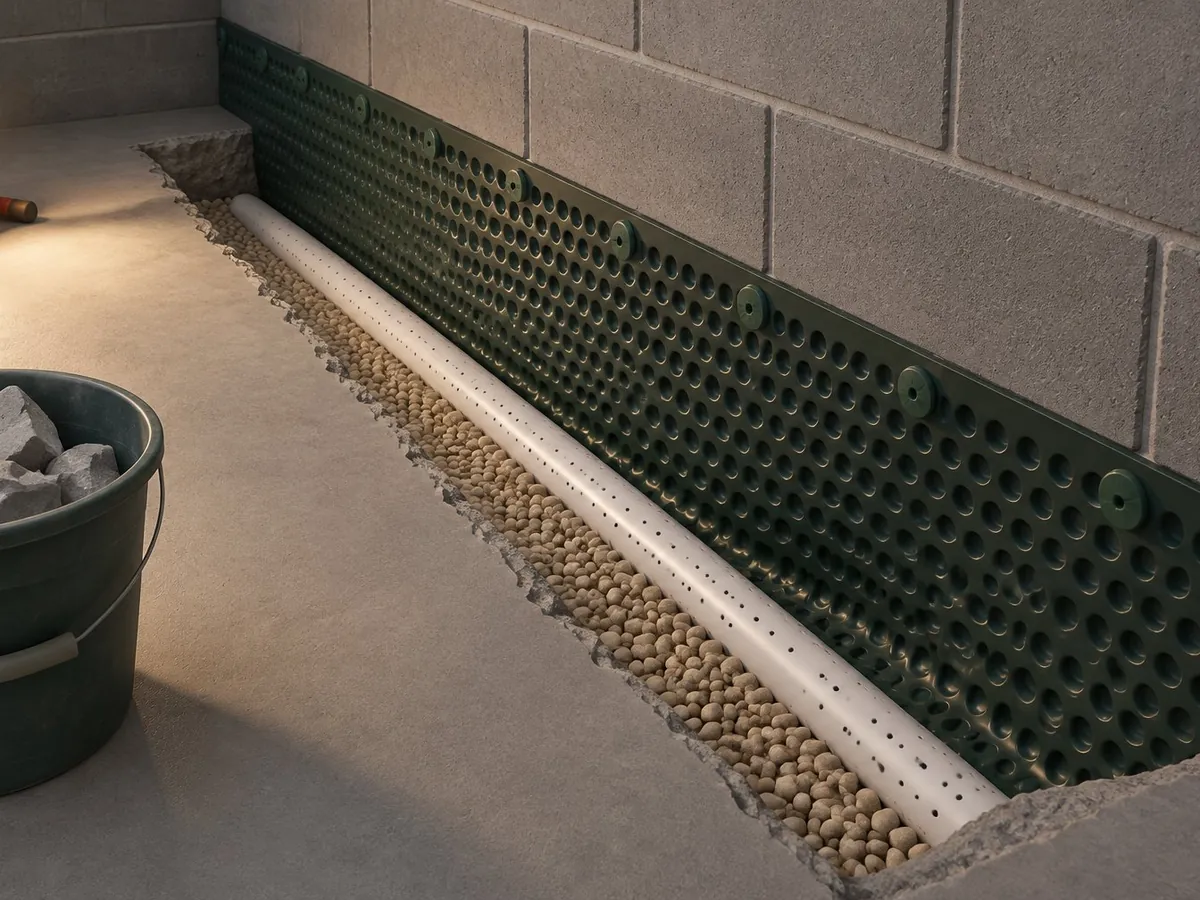
How an interior drain is put in
Clear the walls
Stored things, shelving and the lower part of any wall finish are moved or cut back so the floor edge can be reached.
Open the floor
A strip of the slab along the wall is broken out and the soil beneath dug into a shallow trench.
Lay the drain
Perforated pipe goes in on washed stone, sloped toward a sump basin. On block walls, small holes are often drilled at the base so the cores can empty into the trench.
Fit the wall barrier
A plastic sheet or dimpled board is fixed to the wall and tucked into the trench, so anything that weeps through runs down behind it to the pipe.
Patch and pump
The trench is covered with new concrete and the basin gets its pump and discharge line.
What it does to the house
Breaking concrete is loud and dusty. Ask how the dust will be contained and whether the furnace or air handler should be off while it is done. The new concrete strip will look different from the old floor. Finished walls lose their bottom section, and replacing it is usually a separate job for a carpenter.
The work is inside, so the weather and the garden do not matter much. That is the main reason it is chosen over digging up the outside.
What it will not do
The wall itself stays damp on its outer side, because nothing has changed out there. Paint-on sealers sold for basement walls can slow light dampness but tend to blister where water is under pressure. And a drain that depends on a pump depends on electricity, so ask about a battery backup.
Questions that sort good proposals from thin ones
- Does the drain run along every wall or only some? Water moves sideways. A partial system can shift the leak to the next wall.
- Are there access ports for flushing the pipe? Fine silt settles in drains over the years.
- What happens at the stairs, the water heater and the furnace? These are where trenches get skipped.
- Does the warranty pass to a buyer if I sell? Have the terms in writing, including what voids them.
Basement questions
Is inside or outside waterproofing the right choice?
Inside systems manage water after it reaches the wall and are less disruptive. Outside work stops it at the wall and protects the masonry, but means digging. Some houses get an outside fix on one bad wall and an inside drain on the others. Ask the company to explain its choice for your house.
Can I finish the basement afterwards?
Many people do. Wait until the system has been through a few heavy rains, and keep the access ports and the sump lid reachable behind any new walls.
Tell someone what you are seeing
Call and describe what is going on under the house or in the basement. You will be put through to an independent local waterproofing company that works in your part of Tuscaloosa County.
Calls may be recorded. The company pays this site for the introduction. See the referral disclosure.